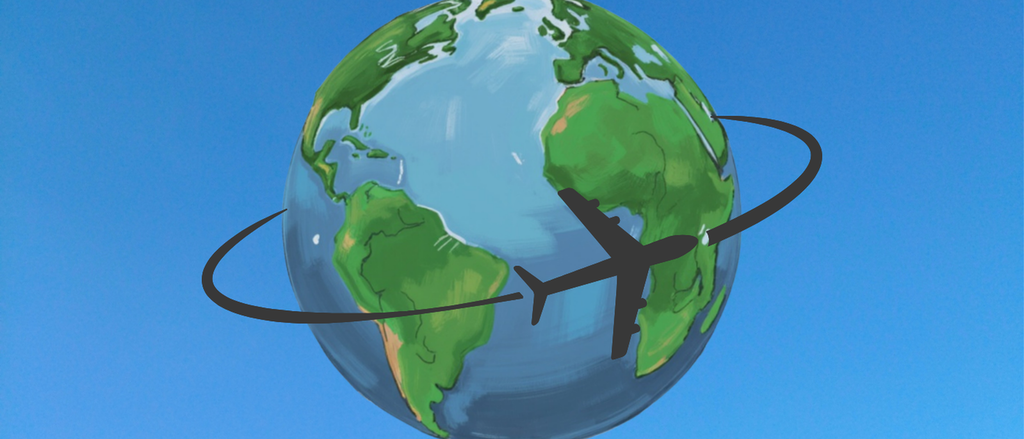
Aircraft pollution and its real impact on the climate
Tuesday, July 7, 2026
Aviation accounts for around 2.5% of global CO₂ emissions, yet it has contributed approximately 4% to human-induced global warming to date. That gap is explained by something most people have never heard of: contrails. This article breaks down what aircraft pollution actually involves, what the latest data shows, and what passengers and policymakers can do about it. Read on for a clear, fact-based overview.
How much do aircraft actually pollute?
In 2019, global aviation emitted approximately 1 billion tonnes of CO₂. That is double the amount produced in 1990, driven almost entirely by rising passenger demand rather than any shortfall in efficiency gains. (Source: Bergero et al., 2023, Nature Sustainability)
Aviation emissions grew faster than any other transport sector before the COVID-19 pandemic. In Europe, they more than doubled between 1990 and 2019, rising from 1.5% to 4.7% of all European greenhouse gas emissions. By 2025, levels had already exceeded pre-pandemic highs and crossed 5% of European emissions. (Source: Transport & Environment, 2025)
The global trajectory is equally steep. Aviation emissions were 70% higher in 2020 than in 2005, and without significant action, they could grow by 300% by 2050. (Source: European Parliament)
What types of pollution do aircraft produce?
Aircraft pollution is not simply a CO₂ problem. Jet engines release a range of gases and particles at high altitude, each with distinct environmental effects.
CO₂ and fuel efficiency
Carbon dioxide is the most familiar pollutant. Burning one litre of jet fuel produces roughly 2.5 kg of CO₂.
Aircraft have become substantially more efficient. In 1990, one passenger-kilometre produced around 357 grams of CO₂. By 2019, that figure had dropped to 157 grams, thanks to improved engine design, larger aircraft, and better seat utilisation. (Source: Bergero et al., 2023)
Despite this progress, total emissions still doubled over the same period. Efficiency gains have been outpaced by demand growth.
How contrails and NOx add to aviation's warming impact
CO₂ is only part of the story. Aircraft also emit:
- Nitrogen oxides (NOx) — which react with the atmosphere to form ozone and reduce methane, creating a complex mix of warming and cooling effects
- Water vapour and soot — which combine at altitude to form contrails
- Sulfur oxides (SOx) — which affect atmospheric chemistry
- Ultrafine particles — linked to serious health risks for communities near airports, with over 52 million Europeans estimated to live within 20 km of major European airports (Source: Transport & Environment)
Contrails deserve particular attention. They form when aircraft fly through cold, humid regions of the atmosphere, leaving behind ice-crystal trails that act like a thin heat-trapping blanket. They persist for hours and can spread into large cirrus clouds.
When all non-CO₂ effects are included, aviation's total contribution to global warming is estimated at around 4%, even though its annual CO₂ share is just 2.5%. Non-CO₂ forcings account for approximately two-thirds of aviation's total climate impact. (Source: Lee et al., 2021, Atmospheric Environment; Klöwer et al., 2021, Environmental Research Letters)
Aircraft pollution vs other forms of transport
Flying is generally the most carbon-intensive way to travel per kilometre. A short-haul flight typically emits more CO₂ per passenger than the equivalent car journey with multiple occupants, and far more than an equivalent train journey.
The comparison is not always straightforward. Long-haul flights spread their emissions across thousands of kilometres, sometimes producing a lower per-kilometre footprint than short hops. But simple CO₂ comparisons miss the non-CO₂ warming effects that occur at altitude, where their impact is amplified.
For most journeys under 1,000 km, rail is a significantly lower-carbon option.
Who is responsible for most aviation emissions?
Aviation's emissions are strikingly concentrated. Studies estimate that only 10% of the world's population flies in any given year. Yet that group generates all commercial aviation emissions. Within that 10%, the concentration is even sharper: just 1% of the global population accounts for around 50% of all aviation emissions. (Source: Transport & Environment; Gössling & Humpe, 2020, Global Environmental Change)
Frequent business travellers and high-income individuals in wealthy nations drive the bulk of the sector's climate footprint. This has implications for how both policy and individual behaviour change should be targeted.
What is being done to reduce aircraft pollution?
Sustainable aviation fuels
Sustainable aviation fuels (SAF), particularly e-kerosene produced using renewable electricity and captured CO₂, can reduce lifecycle emissions significantly compared to conventional jet fuel. The EU has introduced mandates requiring airlines to blend increasing shares of SAF into their fuel supply.
The challenge is scale. SAF currently represents a tiny fraction of global jet fuel consumption, and producing it at the volumes needed would require enormous amounts of renewable energy. It is a promising part of the solution but is unlikely to be sufficient on its own.
Contrail avoidance
One of the most practical near-term interventions costs very little: adjusting flight paths by small amounts to avoid the cold, humid atmospheric zones where contrails form. Real-world trials have confirmed this can substantially reduce contrail warming. Some researchers now argue that contrail management could be the most effective tool for cutting aviation's climate impact before 2050. (Source: International Council on Clean Transportation, 2025)
The EU began monitoring non-CO₂ emissions from all flights departing Europe in 2025, with potential legislation from the European Commission expected in 2027.
Flying less
Before cleaner fuels and zero-emission aircraft are viable at scale, reducing demand remains the most direct path to cutting emissions. During the COVID-19 pandemic, many organisations showed that a significant share of business travel can be replaced with remote alternatives. Cutting corporate travel to 50% of pre-pandemic levels could reduce European CO₂ emissions by as much as 32.6 million tonnes by 2030, equivalent to removing 16 million cars from the road. (Source: Transport & Environment)
What can you do as a passenger?
It's not easy to fix a structural problem with individual action, but a few choices do make a measurable difference:
- Fly direct where possible. Take-off and landing burn the most fuel. Fewer connections mean lower emissions per trip.
- Choose economy class. Business and first-class seats carry a larger per-passenger footprint because they occupy more physical space.
- Take fewer, longer trips rather than multiple short flights.
- Travel by train for journeys under a few hours where alternatives exist.
- Ask about SAF. Some airlines publish SAF usage data; it is worth knowing which carriers are investing in cleaner fuels.
Frequently asked questions about aircraft pollution
What percentage of global CO₂ emissions come from aircraft?
Aviation accounts for approximately 2.5% of global CO₂ emissions from fossil fuels, based on 2019 data. When non-CO₂ warming effects are included, such as contrails and nitrogen oxides, aviation's total contribution to human-induced global warming rises to around 4%. (Source: Lee et al., 2021)
Are contrails really that damaging to the climate?
Yes. Contrails and the cirrus clouds they generate are estimated to have caused more warming over time than all of aviation's historical CO₂ emissions combined. Their effect is short-lived compared to CO₂, but at any moment they are a major driver of aviation's total climate impact.
Is flying worse than driving for the environment?
For most journeys, yes. Flying produces more CO₂ per passenger than driving with multiple occupants, and considerably more than train travel. The gap is largest on short-haul routes, where non-CO₂ warming effects at altitude also increase the overall climate impact.
Can sustainable aviation fuels solve the problem?
SAF can reduce lifecycle emissions significantly compared to standard jet fuel. But current production covers only a small share of global aviation demand, and scaling it up requires vast renewable energy resources. SAF is part of the solution, not the complete answer.
What is being done at a regulatory level?
The EU has started monitoring non-CO₂ aviation emissions on all departing flights from 2025, with potential new legislation expected in 2027. ICAO, the UN's aviation body, has set a net-zero target for international aviation by 2050, though the specific mechanisms to achieve it remain under discussion.
Your rights as a passenger when flights go wrong
Aircraft pollution is not the only issue passengers deal with. Delays, cancellations, and denied boarding are frustrating, but under EU261, you may be entitled to financial compensation.
Here is when you may have a valid claim:
- Flight delayed by 3 or more hours at your final destination
- Flight cancelled less than 14 days before departure
- Denied boarding due to overbooking or operational reasons
Compensation depends on the flight distance:
| Flight distance | Potential compensation under EU 261 |
|---|---|
| Up to 1,500 km | Up to €250 |
| 1,500–3,500 km | Up to €400 |
| Over 3,500 km | Up to €600 |
Amounts are per passenger, per flight, according to EU261.
Not every disruption qualifies. Delays caused by extraordinary circumstances — severe weather, air traffic control decisions, or events outside the airline's control — are generally excluded. But many disruptions do qualify, and most passengers never claim because they do not know their rights or find the process too complicated to navigate alone.
AirRefund.com/en handles the claim on your behalf. You submit your flight details, and the team takes it from there: assessing eligibility, contacting the airline, and pursuing the compensation you may be owed. No win, no fee.
Check your eligibility with AirRefund.com/en.
Sources
- Bergero, C., Gosnell, G., Gielen, D., Kang, S., Bazilian, M., & Davis, S. J. (2023). Pathways to net-zero emissions from aviation. Nature Sustainability, 6(4), 404–414. nature.com
- Lee, D. S., Fahey, D. W., Skowron, A., et al. (2021). The contribution of global aviation to anthropogenic climate forcing from 2000 to 2018. Atmospheric Environment. sciencedirect.com
- Klöwer, M., Allen, M. R., Lee, D. S., et al. (2021). Quantifying aviation's contribution to global warming. Environmental Research Letters. iopscience.iop.org
- Gössling, S., & Humpe, A. (2020). The global scale, distribution and growth of aviation: Implications for climate change. Global Environmental Change, 65, 102194.
- Transport & Environment (2025). Airplane pollution. transportenvironment.org
- International Council on Clean Transportation (2025). Aviation vision 2050. theicct.org
- Ritchie, H. (2024). What share of global CO₂ emissions come from aviation? Our World in Data. ourworldindata.org



Did you like this content ?
Thanks you made our day!
Help us be better!
Well received, thanks!